Wednesday, June 26, 2013

IT'S CALLED FOOTBALL!


Hi everyone,
Today's topic is football.

As a life long football fan, it never ceases to amaze me that there are people in certain places around the world that refer to my beloved sport as ‘soccer’. The reason that they do this, is always because they have their own version of football which, mostly, has very little resemblance to football. Now before you start pointing across the Atlantic, it’s not just in the USA where they call football soccer, there are other places across the world where the noble sport of football is referred to by the wrong name, and we will start this tour of mistranslation right here on my own doorstep in Croke Park, Dublin. 

GAELIC FOOTBALL
The Game: 
Gaelic Football is a game where 2 teams consisting of 15 players each try to score by kicking or punching  a round ball that looks closely like a volleyball through the goal posts, and by kicking the shit out of each other. The game is most often described as a cross between football and rugby and the goal is also a cross between a football goal and a rugby goal.

                                                       As you can see here

Points are scored when the ball is kicked or punched through the goal posts, with a ball above the bar worth 1 point and a ball in the goal worth 3 points.  A game consists of two 35 minute halves. 

Where is it popular?
Ireland. And in places with large numbers of Irish migrants, but the only country where it is played at a high level is Ireland.  County Kerry is the record champion with 36 titles, followed by Dublin with 23 Championships.
Excitement level: 70%

A top level Gaelic football match is generally very good stuff to watch. It is fast, technical and there's a lot of scoring. Oh yeah, fights regularly break out on the pitch during matches.
If you're ever in Ireland during the season, go watch a game at Croke Park, it's a great experience.

How FOOTBALL is it?

50%. While most points scored from distance are kicked over the bar, the majority of passing is done by hand and a lot of points scored from close to the goal are also punched in, rather than kicked.


RUGBY FOOTBALL

The Game:


Rugby is a game where 30 men with the build of Arnold Schwarzenegger and the mindset of a troop of Uruk-Hai run into each other while stamping on the opposing team with spikey boots. Perhaps not surprisingly, it's very popular in Australia.

The game as we know it now, as legend has it, was invented in 1823 when a guy named William Webb Ellis, who was playing football for a school in the town of Rugby in England, East of Birmingham decided that the rules of football were too complicated and decided to pick up the ball with his hands and transport it into the goal that way. Whenever this story pops up, officials from the International Rugby Union fall over each other to say that this is not true because their game is much older than that and in any case, Webb Ellis had nothing to do with it. It is perhaps interesting to note that those same officials, when they had to come up with a name for the Rugby World Cup, decided to name it the William Webb Ellis Cup.
In rugby, the aim of the game is to run the ball into the opponents goal area and then touch it down on the ground. This is called a Try and is worth 5 points. After scoring a try, you also get a kick at goal (the conversion) which is worth an additional 2 points. What is also interesting to know is that, in the early days of the game, a try was not worth any points. The reason for attempting to score a try was that you would then get an attempt (a try if you will) to kick at goal for a point. That's why a try is called a try.

Where is it popular?
The British Isles, Australia, New Zealand and South Africa.

Excitement level: 75%. Rugby is a tough game for hard men. A well executed try is a joy to watch and both teams will generally keep battling until the very end. The main point of criticism that you will hear from people who aren't into rugby is that too much time is spent in human octopus situations, when up to a dozen players are on top of the ball, trying to push the other team out of the way.

How FOOTBALL is it?
30%. There are basically 3 scenarios in rugby where the ball is kicked:
- You just scored a try and are attempting a conversion
- You find yourself in an unenviable position deep in your own half, with the opposing team charging at you. There is no player from your own team nearby that you can offload the ball to so your only option is to kick the ball as far away as possible and hope it bounces out of play in the opponents' half so you can restart play from there.
- You are running out of options to play on for a try and decide to take a dropkick at goal. You won’t score a try but, hey, 3 points is better than no points.

Actually, there is a fourth scenario where kicking is involved: You are the English rugby team during the first decade of the 21st century and you play a particularly chicken dick style of rugby wherein your game plan is not even to score a try, but simply to keep the opponents at bay and play to your miracle kicker Johnny Wilkinson so he can score 3 points from a dropgoal. Who needs a try when you can have Johnny boy kick 7 or 8 dropgoals each game? 


AMERICAN FOOTBALL


The Game:
In American Football, two teams of 11 players play on a pitch that is about as long as a normal football pitch, but slightly narrower. The aim of the game is for the attacking team to advance an oval bar 10 yards in 4 attempts (‘downs’). If the attacking team succeeds, they are rewarded another set of 4 downs to advance 10 yards, and so on. The goal of the defending team is to shove the attacking team so far under the surface that they can tell them what the weather is like in China by the time they are dug up again. When the team in offense manage to get the ball to the end zone of the defending team, a Touch Down is scored, worth 6 points. The scoring team then gets an attempt to kick the ball between the goal posts for another point. In rare situations, teams can choose not to take the kick, but to try and score another touchdown from their last position, which is then worth 2 points. This play is commonly known as the ‘2 point conversion’ (No shit) and is generally only played if the clock is running out and the team that just scored a touchdown needs 2 extra points to tie or win the game.  The game originally evolved from rugby in the colonial days, with the major distinction that the rugby rule of ‘Thou shalt not go forward’ was so against American nature that they eliminated it very soon.  The game moved on from there.


Critics of the game always point out the start-stop nature of the game and the fact that a 60 minute game takes over 3 hours to finish. While this is undoubdtedly true, this is simply the nature of the game. American Football is a very tactical game, that requires tweaking of the combat plan after every play.
The NFL (National Football League) is the most popular league in America and the season’s final (The Superbowl) is one of the best watched sporting events on the calendar, world wide.

Where is it popular?
The USA, though interest is on the rise in Europe, especially in Ireland, Great Britain and Germany.  Rumors suggest that the NFL is considering starting or relocating a franchise in London or Frankfurt but, believe me, this will not happen. (I’ll explain why in a later story, so hold that thought).

Excitement level:  90%. American Football is spectacular in every facet of the game.
If you can’t get your head around the tactical start-stop nature of the game, you may not share this opinion.

How FOOTBALL is it?
20%.  Like in rugby, kicking only happens after a scoring play, or if a team finds themselves caught in a corner with no obvious way out. Or, ofcourse, if you need 3 points with only a couple of seconds remaining in the game.


AUSTRALIAN RULES FOOTBALL
The Game:
The funny thing here is that the only game that has the term ‘Rules’ in the name, seemingly has no rules in any meaningful sense of the word. 2 teams of 18 players try to remove possession of an oval ball from the opposing team. If the opponent does not comply, they will normally punch them in the face, pull their ears or nose or simply kick them. But preferrably punch them in the face. Games are played on cricket pitches, which may seem odd, until you realise that the game was developed in Australia’s colonial days to keep cricket players in shape during the off-season. The cricket origins of the game still show in the trait of players wanting to hit anything that comes at them. Players can move the ball by hand-passing it, kicking it to a team mate, or by punching an opponent in the face.
That’s pretty much it, as far as the rules go. 


Oh, wait, the scoring system! 
As you can see here:


a goal consists of 2 tall goal posts and 2 slightly shorter ones on the outside. If you manage to kick the ball in between the 2 tall posts without somebody punching you in the face, that is called a goal and worth 6 points. If your shot ends up between a tall post and a shorter one, arguably because your aim was off as a result of one of your opponents punching you in the face,  that is called a behind and worth 1 point.  In the early days of the game, additional points were awarded for punching an opponent in the face, but when the sports regulatory body realised that this would necessitate 5 digit score boards, the idea was dropped. [Citation needed]

Where is it popular?
Australia. And places were a lot of Australian people live, which basically means London.

Excitement level: 
80%. Australian Rules Football is a very energetic game, with lots of scoring and played at a murderous pace.
90% if you’re into mixed martial arts.
100% if you’re from Melbourne.

How FOOTBALL is it?
60%. Perhaps because of the huge pitches, transfer of the ball happens mostly through kicking. Points from distance are always kicked, as are most scores from closer to the goal. Still, a lot of handpassing goes on when approaching the goal posts, to create fast-paced ball movement to confuse the defending team, and avoid a punch in the face.


So, while all of these games are great to watch, none of them deserve the name football as football does. Football is the only game where ball movement and scoring is only allowed by using your feet (okay, and your head).  Fans of the games mentioned above often have 2 main points of criticism towards football:
-       -    Football is boring because very few goals are scored.

While it is true that in a lot of football games only 3 or less goals are scored during a game, there are some obvious reasons for this. First of all, football is the only one of these games where there is only one way of scoring points.  All the other games have at least 2 ways of scoring. Then on top of that, football goals are small. Sure, a gaelic football goal is the same size, but then you have the goal posts that you can kick between from 30 or 40 yards out and there is not a goal keeper that can do anything about it if the ball is 15 feet up in the air. The same thing goes for Aussie Rules, rugby and American football- you can take pot shots at goal from half way up the pitch and there’s not a thing anything anybody can do about it, guaranteeing that you can rack up points from distance. You can put Shaquille O’Neal in front of the goal posts, but even he would need a considerably tall stepladder to have any chance of blocking the high shots. Then, ofcourse,  in American Football and rugby, the entire width of the pitch is the goal, which makes it easier to get a point in. 

-          - Football games always end in a draw.
It is true that draws occur often in football. And again, there are reasons why that doesn’t happen as often, or even at all, in the other games. First, all American sports simply play overtime until there is a winner, thus eliminating even the possibility of a draw. I watched a hockey game just last week, and instead of the normal 3x20 minutes game, it turned into a triple overtime spectacle that lasted until 5.50 in the morning. With the 3 overtime periods, the teams had effectively played 2 entire games in a row. Eventually, some player will lose focus and let in a goal.  Baseball games, too, regularly have 3 or 4 extra innings, and they will simply play on until one of the teams end an inning with a higher points total than the opponent.  Apart from that, all the other games have different value scoring opportunities. In Aussie rules, you can score 1 or 6 points on each attempt. In gaelic football, you can score 1 or 3 points. American football gives you the opportunity to score 6, 1, 2 or 3 points at the various scoring scenarios. In football, no matter how you score, it is always worth 1 point. You can make the goal of the season, score an overhead bicycle kick from the 18 yard line, after doing 2 cartwheels while jumping through a burning hoop, you will still only get 1 point. It is obvious that in such a set up, a draw is much more likely to happen than in a game where every way of scoring gives you a different number of points.
Finally, the criticism on diving football players is justified. Every football supporter I know hates it. Nearly every football fan I know is in favour of video refs to decide on divers, off-side goals and other things that are hard to catch during the game. However, unlike in pretty much every other major sport, the powers that be keep delaying decisions on this matter. 
In the end, you can simply kill off all criticism on our sport with one simple reply:
IT’S CALLED FOOTBALL!


Tuesday, May 14, 2013

Goodbye Snow


On the bus from Minsk to Grodna, we drove out of town past most of the buildings and sites we had visited during our stay. It was a weird experience to drive by these majestic buildings and statues knowing that this would most likely be the last time in my life that I saw them. It's not because I didn't like Minsk or didn't find it interesting, but I can't see myself running back to Belarus in a hurry. First of all there is all the hassle of getting INTO  the country, both in preparation (visas were expensive and difficult to get) and when you get there (remember the border control back at the start of the story?). Then there is the fact that we'd easily exhausted the entertainment options in the space of 3 days and the absence of a meaningful party scene that can normally keep you busy even in places that completely lack cultural or architectural diversions. The first time I got off the subway in New York, I knew I would make many visits to the city. I will very likely make return visits to places like Bratislava and Sarajevo because I really enjoyed myself there. I know I'll be back in Sydney. Minsk, however, was a once in a lifetime experience, unless I win an all-expenses-paid trip there.

                                           Goodbye, Huge square


I won't bore you with the details of the trip to Grodna because there were no details. As soon as we left Minsk, there it was again: the never ending mountains of snow as far as the eye could see. I lost myself in my book immediately. I woke from my reading when Renae pointed out that we were approaching a city. I startled from my book in that vague state of limbo that you enter when you fall asleep in daytime and wake up to daylight and realise that you have no idea what time of day it is. Did you doze off for a couple of minutes? A couple of hours maybe? Or was it the next morning? Looking up from my book, I just couldn't tell if I had been reading for 10 minutes or 4 hours. It turned that it had been close to 4 hours as we were nearing Grodna. We got off the bus and directly went about our task of getting bus tickets back to Lithuania for the next day. There was only one bus a day so we absolutely HAD to be on that  because our visas would expire the next day and I really, seriously, didn't want to contemplate the amount of shit we would be in if we were stopped at the border with expired visa papers. A friend of a friend had once shown up at the border between Belarus and Poland with a visa that was 1(one) day overdue, demanding to exit the country and was promptly sent back on a 6 hour bus trip to Minsk and ordered to contact her national embassy and a host of local burocrats to obtain clearance and a flutter of forms in order to be allowed to leave. This thought alone made sweat well up on my neck and I was glad when we got our bus tickets. Where in Minsk we had had a more or less comprehensible map of the city, in Grodna we had to go by a print out of Google Maps. Maps of Grodna exist only in Grodna.
                                    A Map of Grodna, as available in the West


After half an hour of walking around in circles we finally managed to locate our hotel. After checking in and doing all the normal stuff you do in a hotel (jumping up and down on the bed, switching on all the lights, stealing all the small shampoo bottles, you know the drill)  we set out to explore the town. The main attraction, it would appear, was the abundance of fairy tale churches. They were everywhere. We walked around, admiring the churches and then, inevitably, stumbled upon a square with a large, stately building and a massive statue of our old friend Lenin.   


The Great Leader of the People was wearing a fishermen’s cap for the occasion and looked out sternly over the town. Grodna was a nice little city, but there is one thing I did not understand. The reason that we had put it on the itinerary, was because it was listed in one of those books of “501 locations you must visit before you die”.  As I said about 2 lines ago, it was a nice little city but I could not see why it would have been listed in that book, while places like, say, Stirling or Oakland or Malaga were not.  The main attraction of the town are those Disney-castle churches and to be honest, I had pretty much seen enough churches by now. 


           This one was pretty cool though


We had dinner at a really cool traditional restaurant. We were first asked to put our coats in the coatroom and then sat down at the table. While waiting for our food, and looking at the lay out of the place, at the exact same moment we both said “This would be a great place for weddings!”.  Strange how you sometimes have those moments. The food, again, was really nice and both the food and the beer were considerably cheaper than in Minsk.  As we were approaching the end of our time in Belarus and didn’t want to be stuck with any worthless money, we sort of had to budget around our last money without having to go to an ATM again. We had an extra beer after dinner and decided to spend the rest of the money on food for the trip back to Lithuania. 

The next morning, we had a final walk around the town, bought a bag full of candy and cookies to keep us occupied on the bus to Kaunas. In the supermarket we were approached by what I would guess was the store manager. I was taking a picture of the beer aisle (something I always do) and apparently this was not to his liking and he urged us to put away our cameras at once and depart.


We had already kept aside some of the currency as souvenirs (and to have an interesting story for in the pub) so Renae decided to give our final 20.000 or so roubles to local beggars. We walked by another church, and I had noticed that a rather battered looking homeless guy was always standing near the entrance. On each of the 3 occasions we had walked by, he was there, holding a dirty beanie and asking for money. We decided to have a look inside the church. When we approached the entrance, I noticed that the beggar smelled like shit. And I don’t mean that he had that token homeless people smell, that comes with irregular showers and sleeping under bridges. No, he literally smelled of human excrement. It was appalling. Renae threw a pack of currency in his hat and we went inside. In my mind’s eye, I had a cartoonesque view of the beggar, upon receiving such a generous donation,  taking a good look at his new found fortune and running off to a liquor store or the race track. When we came out of the church about 3 minutes later, sure enough, he was gone.


I donated the other 10.000 roubles to a young girl in a wheel chair outside a supermarkt and we got on the bus back to the free world.  It turned out we could easily have gotten tickets on the day itself because the 50 seater bus had a grand total of 4 passengers. Better safe than sorry though.  When we got to the border, I wanted to make sure we were first in line, even though there were only 4 people on the bus, but before we could get off, a serious looking border guard came in and collected all our passports and then checked the toilet to see if anyone was hiding in there. He walked to a cabin beside the road, where some 20 people were shuffling in the cold, waiting to be waved through. Due to our exalted status of bus passengers,  the border guard saved us quite a lot of time by jumping the queue for us. While he was doing some important stamping and visa checking, another guard came onto the bus, and checked the toilet again. Do people really still hide in bus toilets when trying to illegally cross a border?  Within 10 minutes we were across the border and back in the European Union. It might sound a bit overly dramatic, but I was glad to drive past the European Union sign and back into Lithuania. 
We arrived in Kaunas as daylight started to fade. A 10 minute walk took us to our hostel where we checked in and had a chat with  the manager. As a big fan of staying in hostels, I was glad to be staying in one again. I have nothing against hotels, but when given the choice I prefer to stay in hostels. The atmosphere is generally better, it’s easy to meet other people and you can always have a party with the other people staying there. Hotels are generally more business like and people do not stay there to meet others. I took an instant liking to Kaunas. I don’t know why, but I just liked the way it looked, the way it was laid out and the way the people went about their business.  We had a meal at a traditional Lithuanian restaurant, which was really nice, apart from the pig’s foot that came with the main course we shared. I’m not going to go into details (you, my dear reader, may be eating) but pig’s feet go in the same bucket as pig’s ears and chicken gizzards.  After dinner, Renae decided to have an early night, and I decided to go into town and check out some bars. The hostel guy had shown me where to find a heavy metal bar, a basement location that could only be reached by crossing a darkened parking lot and going down a stair case. When I found it, it turned out to be closed. I went to a different bar and despite it being nearly 11PM, there was still live Champions League football on tv because of the 2 hour time difference with Ireland. I appreciated this very much and watched the rest of the match and stayed until nearly closing time, enjoying many pints. 

We had to get back to Vilnius that afternoon to catch our flight back to Dublin, so our sight seeing time was rather limited. Fortunately,  we had only 2 things on our to-do list, the Old Town and Kaunas Castle. We started out at the castle, which was nothing like I expected. Castle tours normally bang on about the history of the castle and when it was built and what role it played in important battles and so on. This was included in the castle experience, but only in the basement, where a couple of plaques commemorated historical stuff and a model showed how it had been rebuilt throughout the years. The rest of the castle was mostly filled with art exhibitions, which was a nice change from your regular castle visit. I especially liked the work of a Lithuanian painter called Kloshar, whose works mostly consisted of brightly colored city scapes and other urban scenes that really appealled to me. 

The Old Town was basically like any other old town in Eastern Europe, so you can paint your own picture of that. What did stand out in the old town, was a bizarre bar/restaurant called the Crazy House. It was, in fact, really weird.It had a number of seats that were actually toilets, chains hanging from the wall and, well, the whole place had the look of an asylum for the insane, which was probably the idea given the name. The food was nice though and the beer cold, so it all made for a nice lunch.  Having ticked Minsk, Grodna and Kaunas off the list, it was time to head back to Vilnius for our flight back to Dublin. We got to Vilnius with a couple of hours to spare, so we walked around for a bit, had a couple of drinks and went back to Cili Kaimas for dinner where we had another fine meal. 

And so ended our trip to the barren, snowfilled lands of the East. Back at the airport, I spent some time trying to drink all my remaining Lithuanian money, but I didn’t quite manage it. As the airline also wouldn’t take Lithuanian money, I still have some 30 Litus left, enough for about 5 pints.  The money now sits in my foreign currency pint glass, and is in the good company of about a dozen other currencies.
It was an interesting trip, though it confirmed my hatred for snow and sub-zero temperatures. Vilnius was a nice city, and I will go back there sometime in the near future to have another look around, and spend my left over beer money. Kaunas looked promising too, but I only got to scratch the surface due to the limited time spent there.  As I said earlier, Minsk was a big surprise. It was big, clean and very well organised. It was a very interesting city but it appears to be somewhat limited when it comes to entertainment options.  All in all, it was a week well spent and visiting a paranoid dictatorship was certainly a different experience.  Next up.. Spain.

Wednesday, May 8, 2013

Goodbye Minsk


Another thing that illustrates how isolated Belarus is, is the fact that hardly anyone speaks English. Now I don't want to state that the ability to speak English is the sole indicator of sophistication around the world but it goes a long way to see how connected a place is to the rest of the world. In Bratislava, for example, pretty much everyone spoke English when I got there. In Slovenia, most billboards were in English. Hell, even in Bosnia I was able to get around speaking English, and that was in Sarajevo, a mainly Muslim city and about as far removed from English culture as you can get in Europe. In Belarus, however, English will get you pretty much nowhere. 


                                          Any guesses?


This was brought home to me when we were looking for a museum about the history of Minsk and we couldn't quite find it. It wasn't until we showed someone a flyer of the museum that we got a vague wave of the hand directing us in the general direction. In the end, we didn't find the museum we were looking for but we did walk into an exposition which, I think, was about the history of cameras. In any case, the lady at the entrance booth didn't speak English either so we were none the wiser. Looking back on it now, she may have been asking for the entry fee or something like that. With our search for history and culture rapidly ended, we decided to go for the other global culture: the one of drinking. On our way to the elusive museum, we had spotted a bar that looked like a rock pub, so we went in it now. We were, in fact, correct in our assumption as the place was decorated with guitars, cymbals and old concert posters. Even the floor was done up with lots of band logos, which  looked pretty fukcing cool. As I had a look around, I did actually find it a bit too nice. 

                          TNT Bar, about as busy as when we were there.

Heavy metal bars the world over nearly always have a certain air about them, divey without being too threatening, rough without being dangerous and there's always a bit of a "you only live once so you might as well enjoy it" vibe. Not here though. Even though it was Sunday mid-afternoon, there was hardly anybody there. I worked in a heavy metal/punk bar in Holland for years and the Sunday afternoon sessions were always legendary, surpassed in madness and drinking only by the Friday night. 


                              Heavy Metal Bars: how it should be done.


Here, however, there was hardly a soul about, the music was in the background more than in your face and the barman spent more time playing with his espresso machine than pouring pints which I have never ever seen before in a rock bar. It was all really strange. That's not to say that it wasn't a nice place, it was just that it was so categorically different from any other rock pub I've ever been in.  What was also different from the usual standard, was the realisation that the place only had one male and one female toilet. Again, I'm not sure how busy it gets here on, say, Saturday nights but in pretty much every heavy metal bar I can think of right now, you can be 100% sure that a 2 toilet policy will result in major logistical problems before midnight.  
In any case, it was a nice, if somewhat strange place, and we had some other things to do, so we set off after we finished our beers. 

 
The next place we went to see was the aforementioned State Department of Important Decisions or whatever it was called, and the place was absolutely huge.  It was so big I couldn’t even get the whole thing in a picture, even from a 100 yards away. There also happened to be another interesting bar in the area, called T34. Those of you with a fascination for Soviet millitary memorabilia, will recognize the T34 as the standard combat tank of the Soviet Union in the middle of the 20th century. 


Even the nazis were afraid of them because they were nearly indestructible. The T34 was produced, roughly, from the early  40s to the late 50s and was the second most built tank in history, after the T54, the model that was developed after it. To give you an idea of how hardcore these tanks were, T34s were still being actively used by armies in 27 countries as late as 1996, nearly 4 decades after they stopped making them. The T54 is still in active use all over the world today.  The reason I bring this up is because there was one standing on a plint on the square where we were now, as a tribute to all the great battles it stood in during the days of the Soviet Union. And an enterprising soul had named a bar after it in the basement of an old KGB building and decorated it with millitary memorabilia. It being situated in a KGB basement, it was sort of hard to find but we got there in the end. It was quite a cool place, most of it in dark colors and with the fading light coming in from the windows near the ceiling it certainly had some atmosphere. But again, there was hardly a soul about. When we were about to leave, a group of about half a dozen people came in and sat at a table in the corner but apart from that it was just the two of us and a guy typing away on an iPad making up the clientele. What do people in Minsk do on Sunday? They certainly aren’t out drinking.
                                   Typical bar in Minsk


With another long day of trudging through the snow behind us, we were looking forward to dinner and a drink. We decided to trace down the local Irish pub which was situated conveniently near our bus stop so we set off for it. We couldn’t find it. We were certainly on the right square but couldn’t for the life of us find it. The pub was supposed to be on number 4 and we had found number 2,3, 5 and 6 but did not see an Irish pub. Until someone walked out of it and we found that we had been standing in front of it for the last 5 minutes. 

 In any other city, whether it is New York, Johannesburg or Belgrade, Irish pubs are always very obviously there. They’re always decked out with Irish flags, Guinness signs and neon signs of shamrocks and leprechauns. More often than not, there’s a tv in the window or a sign outside advertising what games are on tv that day and there are nearly always some people standing outside. In Minsk, however, we could have stood there for another 20 minutes and if no one had come out, we would have been none the wiser. 

                                                                  Normal Irish Pub


Strange place. The pub itself, however was nice and the food we had (smoked salmon and, yes, potatoe pancakes) was excellent.  Tired of another day of snow ploughing, we decided to go back to the hotel.


On our way to the bus stop, one of the local winos walked up to me with an outstretched hand, the wino sign the world over for ‘I’m out of vodka, please give me some change’. I told him that I had no change, which got me a comically grumpy “grmnst, chrttssv Amerikanski hgrghd!” or words to that effect. It was funny to see that I was immediately dubbed an American after refusing to hand him some of his country’s worthless money. 

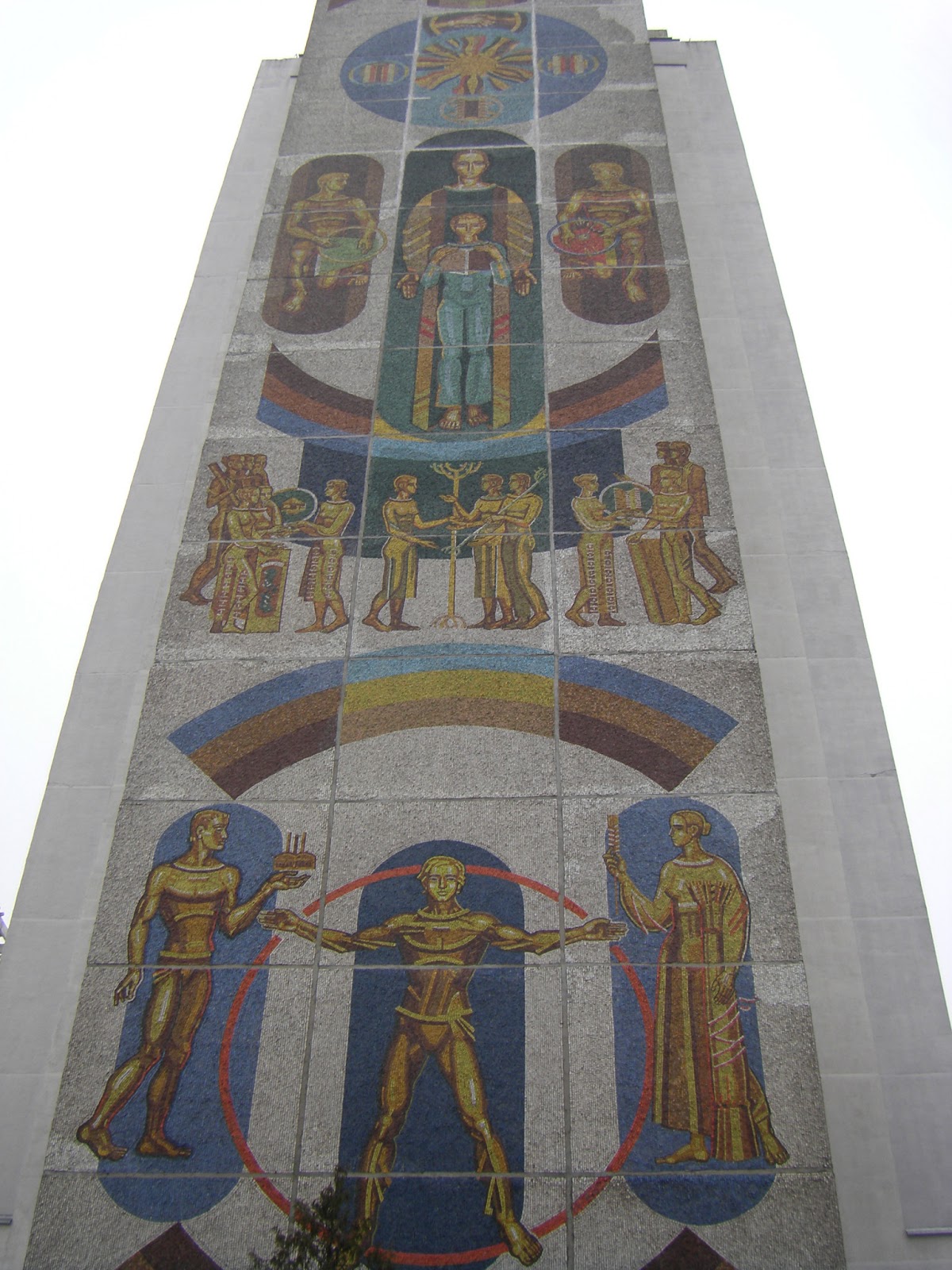
The next day, we found that we had more or less exhausted our entertainment options in Minsk. Interesting as the city may be, after 2 days you have pretty much seen all the interesting buildings, the stadium and sites and if, like us, you can’t find the museums, that’s pretty much it. We took the subway to a residential area in the North East of Minsk to see what that was like. That, again, was quite interesting. The apartment buildings were huge,like everything else. What made it interesting, was that all the buildings had huge Soviet murals painted on the sides. There were 12 story paintings of Soviet astronauts and memorials to the time when the Olympics were in Minsk. 
Minsk never organised the Olympics, but when they were last in Moskou, in 1980, the organisers decided to spread the joy of the Olympics across the Soviet Union and the football stadium in Minsk was one of the main venues for the Olympic football tournament.  To give you an idea of how far spread out these Olympics were, events were staged, among others, in Leningrad (630 km to the North) and, stunningly, in Tallinn, which is nearly 900km from Moscow. Again, the Soviet Union was a ridiculously vast country, about the size of Canada and the USA combined. 


We had lunch at a football-themed pizza place, that had crests of Premier League teams engraved in the windows that separated the booths and jerseys and scarves on the wall.  After lunch we took the subway back to the city centre. The subway operates on a system that is somewhat similar to the one in Philadelphia. You buy little coins that you can use to operate the turnstiles in the stations. In Philadelphia the coins are made of silvery metal and look sort of professional. The ones in Minsk are made of purple plastic which gives it a bit of  a cheap look. The stations are pretty cool though. Like a lot of other things in Minsk, they still look like the Soviet Union was never dissolved. Impressive busts of Lenin stare at you in every station. Big Hammer and Sickles are above every exit. This, combined with the fact that there isn’t a single piece or garbage in the entire city, make that it looks pretty cool. 

Back in the city centre, we spent another half hour trying to buy bus tickets to Grodna, in Western Belarus, where we were going the next day. Buying a ticket in Eastern Europe can be a bit of a task at any time, but if you can’t even begin to imagine which window you have to go to, it takes just that little bit longer.  We spent the rest of the day in the manner that you do when you’re in a foreign city and have done everything you wanted to do and don’t really know what to do until it’s time to go to the next city. We walked around a bit, had a drink in a bar with a middle ages theme (again, it was practically empty) and had a look at Lee Harvey Oswald’s old apartment.  Most people don’t know this, but Lee Harvey Oswald, the man who clearly did not kill JFK, lived in Minsk for 2 years from 1959 until 1961. While there, he planned to attend university, but he was sent to work in an electronics factory where he was assigned a co-worker who had to teach him Russian. This guy, believe it or not, would (much) later become the first prime minister of independent Belarus.
Oswald lived in an imposing yellow apartment building not too far from the cenotaph we had visited earlier. The building consisted of 3 parts but it was unknown in which one exactly he had lived so I took pictures of all 3 of them. We spent the rest of the afternoon wandering around and ended the day with dinner at a traditional Belarusian restaurant with a complex Cyrillic name above the door. It was next to the TGI Friday's were we had had our first lunch on Saturday so in a really lame way we had come full circle in Minsk. The food was great, I must say. We both had a sort of stew consisting of mushrooms, meats and, ofcourse, potatoes, and it was served in a breadbowl. While serving food in a bread bowl is nothing particularly exciting (anybody who's ever been to San Francisco will tell you that after 3 days there you get the urge to dropkick the next breadbowl you encounter into the Pacific Ocean) but this one was exceptionally good. It was made of dark bread and had a taste somewhere halfway between sweet and savoury. It was amazing.

It was also time to go to Grodna.